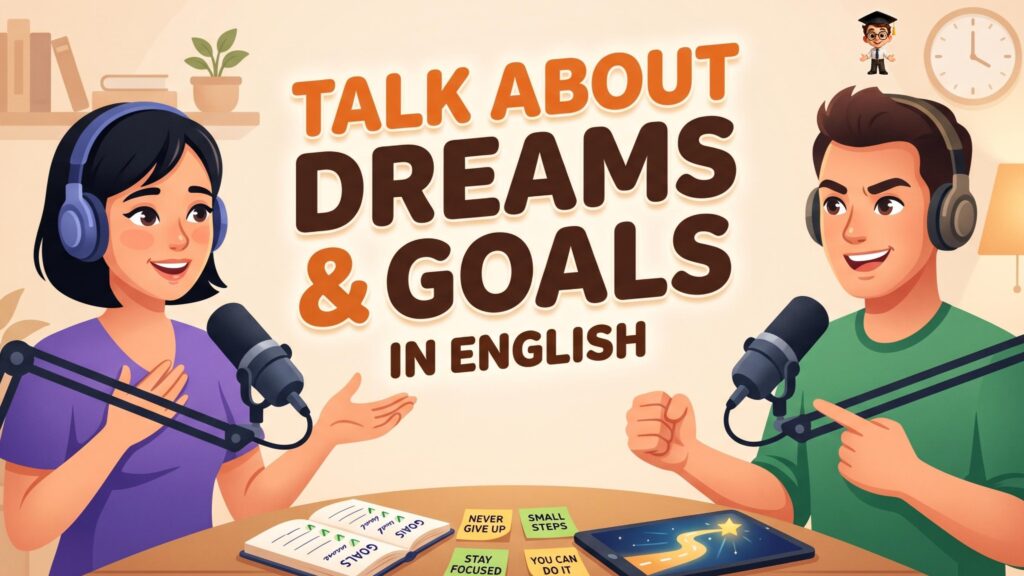
Hello English learners! Welcome to the Mr. English Channel, where learning is always easy and fun. Today, we’re diving into a topic close to our hearts: dreams and goals. Everyone has them, big or small, and understanding how to talk about them in English is a fantastic step toward fluency.
Expressing Your Future Aspirations
When discussing your future plans in English, you have several excellent phrases at your disposal. For simple desires, “I want to” is common and straightforward. For example, “I want to learn English.” If you’re looking for something a bit more serious and focused, “My goal is to” works perfectly. You might say, “My goal is to speak English fluently.” Both phrases are powerful, but “My goal is to” emphasizes a clear intention and commitment.
Childhood Dreams: A Look Back
We all had grand dreams as children! To talk about aspirations from your past, you can use phrases like “I used to dream of” or “I wanted to be.” For instance, our host Emily used to dream of becoming a famous singer, singing pop songs in front of her mirror every day! Our other host, Paul, wanted to be an astronaut and travel to the moon.
It’s completely normal for dreams to evolve as we grow and learn more about ourselves and the world. The dreams you had as a child might be very different from your goals today, and that’s a beautiful part of life.
Dreams vs. Goals: Understanding the Distinction
While often used interchangeably, there’s a helpful distinction between dreams and goals.
- A dream is like a beautiful wish or something you imagine. It’s the grand vision, the ultimate destination.
- A goal, on the other hand, is something you actively work to achieve with clear, actionable steps. It’s the map that guides you to your dream.
For example, if your dream is to live in another country, your goals might include saving money and learning the language. You can express these intentions using phrases like “I am planning to move abroad” or “I am working towards moving abroad.” “I am planning to” shows practical steps are already underway, indicating more certainty.
Overcoming Obstacles on Your Journey
Working towards any goal, especially learning a new language, comes with its challenges. It’s important to recognize and discuss these struggles.
Conquering Fear
Fear is a big one. Many English learners worry, “What if people laugh at me?” or “What if I say the wrong word?” But remember, mistakes are not failures; they are proof that you are trying! They are essential for learning and progress. Don’t let fear stop you.
Dealing with Doubt
Doubt can make us feel like giving up. We might think, “I am not smart enough” or “This is too hard.” These negative thoughts can really slow us down. To talk about this feeling, you can say, “I am having doubts about my progress” or “Sometimes, I feel discouraged.” It’s a common feeling, even for native speakers, so acknowledge it and push through.
Managing Distraction
In today’s noisy world, distraction is everywhere. It’s easy to lose focus when studying, getting caught up in social media or other daily tasks. You can explain this by saying, “I got distracted by my phone” or “I am struggling to stay focused.” Identifying the distraction is the first step to overcoming it.
It’s Never Too Late!
A common misconception is feeling that it’s “too late” to start something new, like learning a language or changing a career. Many adults might say, “I should have started years ago” or “It is too late for me now.” But this is simply not true! Age is just a number when it comes to learning and growing.
Turning Big Dreams into Achievable Steps
The secret to achieving a big, scary dream is to break it down into small, manageable daily steps. Instead of looking at the whole mountain, just focus on the next step. If your dream is to speak English confidently, you don’t need to study for five hours a day; that would be overwhelming.
Instead, focus on just fifteen minutes a day. This small commitment builds consistency, which is more important than speed. You can express this approach by saying, “I am taking it one day at a time” or “I am taking small steps.” These phrases help you stay calm and avoid feeling overwhelmed by the long journey ahead.
Staying Motivated: Remember Your “Why”
When life gets busy and challenges arise, how do you stay focused? The key is to remember your “why” – the deep, personal reason behind your dream. If your goal is to learn English, your “why” might be to get a better job to support your family, or to travel the world and communicate freely.
Remembering your “why” gives you the energy and motivation to keep going, even when you’re tired. You can say, “I am doing this for my future” or “My family is my motivation.” Visualizing your goals also helps. Many people like to write their goals down or keep them in mind, reminding themselves daily of what they are working for. “To keep something in mind” means to remember it and think about it often because it’s important to you.
Boost Your English Learning with Mr. English AI!
Speaking of staying focused and practicing every day, we have an incredible tool to help you do just that: Mr. English AI!
Mr. English AI is an amazing, smart assistant that you can use to chat and practice your English twenty-four hours a day, seven days a week! It’s like having a friendly partner always ready to help you improve your speaking and writing. This unique opportunity allows you to practice the English you learn with us, helping you achieve fluency faster. You can talk about your dreams, your goals, or anything you want, without any pressure. It removes the fear of making mistakes, letting you learn at your own pace.
The link to access Mr. English AI is in the video description. We highly recommend it to everyone who wants to take their English to the next level! For more helpful tips and lessons, you can always read more on our blog.
Essential Phrases for Your English Journey
Here are some simple variations of phrases we’ve discussed today, along with some encouraging words:
- To describe difficulty: Instead of just “It is difficult,” you can also say “It is tough.” (e.g., “Learning English can be tough, but it is worth it.”)
- To achieve a dream: Beyond “I want to achieve my dream,” you can also say “I want to reach my dream” or “I want to fulfill my dream.” “Fulfill a dream” means to make it completely come true, often implying great satisfaction.
- To encourage someone: Simple phrases carry a lot of positive energy: “Keep going!”, “Don’t give up!”, “You can do it!”, and “You are doing great!”
Let’s imagine a quick scenario: If you’re feeling discouraged, a friend might say, “Hey! Don’t give up! You are doing great, and you just need to take it one day at a time. It is never too late! Remember your ‘why’ and keep your goals in mind. You can do it!” Notice how simple, everyday English can express deep feelings and give powerful support.
This demonstrates that powerful English doesn’t need complicated words; it just needs consistent practice. Consistency, doing something regularly, is far more important than speed. Fifteen minutes of study every day is more effective than three hours once a week.
Your Dreams Are Within Reach!
We’ve covered so many wonderful things today, from childhood dreams to daily habits. Remember, your dreams are important, and you have the power to reach them! Take small steps every day, use amazing tools like Mr. English AI, and don’t be afraid of making mistakes.
Thank you for listening and learning with us. If you enjoyed this conversation, please subscribe to the channel, like this video, and leave a comment below. We love connecting with all of you! Goodbye, everyone, and see you in the next episode!