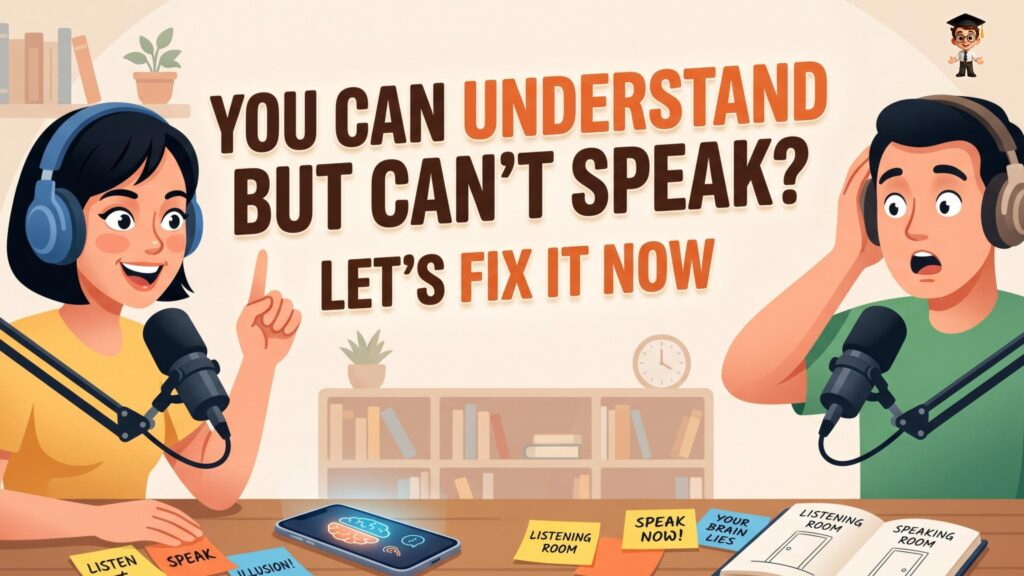
Do you ever feel like you understand everything in English but struggle to speak it? You listen to podcasts, watch movies, and read articles, nodding along, but when it’s your turn to talk, your mind goes blank? If this sounds familiar, you’re not alone. Many English learners experience this frustrating challenge, often leading them to believe they’re not smart enough or their English isn’t good enough. But we’re here to tell you that’s simply not true! This common hurdle is a normal brain phenomenon, and today, we’re revealing the secret to overcoming it.
Our latest episode on the Mr. English Channel dives deep into why this happens and, more importantly, how to fix it. Get ready to transform your English speaking skills with five powerful strategies!
Understanding the “Speaking Block”
The human brain has different “rooms” for language processing. One room is dedicated to listening, which primarily focuses on recognizing words – a passive process, much like recognizing a friend’s face. It requires minimal energy. This is why you can enjoy music without knowing how to play an instrument, or understand English without being able to speak it fluently.
The speaking room, however, is a different story. It’s an active process that demands significant energy. It requires your brain to construct words from scratch, retrieve grammar rules, and organize your thoughts—all at the same time. This distinction often leads to what scientists call the illusion of competence. You feel like an expert when listening, but the moment you try to speak, your working memory gets overloaded, and your brain freezes.
The good news? This is a normal part of language acquisition, and you can absolutely train your brain to move words from your listening “room” to your speaking “room.” Let’s explore how.
Five Game-Changing Strategies to Boost Your English Speaking
1. Changing the Story (Active Reconstruction)
Most students listen passively, absorbing information without actively engaging with it. To boost your speaking, you need to practice active reconstruction. This means taking a simple sentence you hear and deliberately changing it.
How to Practice:
- Hear a sentence: “I go to the supermarket and I buy some milk.”
- Change the time: “Yesterday, I went to the supermarket and I bought some milk.”
- Change the person: “He goes to the supermarket, and he buys some milk.”
This exercise forces your speaking brain to wake up. It makes you naturally practice grammar and verb conjugations without memorizing tedious rules. You’re actively playing with the language you understand, building new connections in your brain.
2. The Layer Game (Vocabulary Retrieval Practice)
Do you find yourself using the same simple words like “good,” “bad,” or “thing” because they’re easy to find? The Layer Game is designed to expand your active vocabulary and help you retrieve better words faster.
How to Practice:
- Choose a simple object, like your smartphone.
- **Layer One:** Describe it in 30 seconds using only very simple words. (e.g., “It’s a phone. It’s black and very good. I use it every day.”)
- **Layer Two:** Describe it again, but this time, you CANNOT use the words you used in Layer One (e.g., “phone,” “good”). (e.g., “This is a modern electronic device. It is extremely useful, and it helps me communicate with my family.”)
This is retrieval practice in action! It trains your brain to search for more precise and varied vocabulary under slight pressure, reducing those “uhm” and “uhh” moments and speeding up your speech.
3. The Pause and Copy Game (Advanced Shadowing)
Traditional shadowing, where you repeat immediately after hearing, mainly trains your mouth muscles. The Pause and Copy Game takes it a step further by engaging your brain’s memory and sentence construction.
How to Practice:
- Listen to a full sentence from an audio source.
- **Pause the audio.**
- Wait for three to five seconds in silence. This seemingly difficult pause forces your short-term memory to actively hold the English sentence structure.
- After the pause, repeat the sentence, copying the native speaker’s exact emotion and rhythm.
This method helps transfer grammar from just a sound you hear to a solid structure you can build yourself. It’s like taking a mental photograph of the sentence, enabling you to speak in full, natural-sounding sentences, not just isolated words.
4. Word Blocks (Chunking for Fluency)
Many English learners make the mistake of trying to build sentences word by word, often by translating directly from their native language. This results in slow, robotic speech. Fluent speakers, however, use “word blocks” – pre-made chunks of language that naturally go together.
Examples of Word Blocks:
- Instead of “solve problem,” use “address an issue.”
- Instead of “reduce risks,” use “mitigate risks.”
- Instead of “collect information,” use “gather requirements.”
The power of word blocks lies in their pre-correct grammar. You don’t have to think about individual word order; you just drop the entire block into your conversation. To practice, stop memorizing single words. Whenever you learn a new word, always learn the “friends” that naturally live with it. This makes your speaking much faster and smoother, as you simply connect a few blocks together.
5. Fast Reacting (Dynamic Conversation Practice)
Scientists confirm that our brains evolve when we’re forced to react quickly in conversation. “Fast Reacting” is about dynamic, back-and-forth talking, pushing your brain to produce language under pressure.
How to Practice:
- Use a voice tool or an AI assistant (like Mr. English AI, mentioned below) and set it up for a fast debate.
- Instruct the AI to disagree with you on a topic.
- Defend your opinion quickly, without time to write or mentally translate.
This intense but exciting exercise forces your brain’s speaking center to work at maximum speed, creating true automaticity in your speech. The more you practice reacting fast, the easier it becomes to speak without hesitation, bypassing that dreaded brain freeze.
Your Journey to Fluent English Starts Now!
These five strategies are designed to help you actively engage with English, moving it from passive understanding to confident, automatic speaking. Remember, speaking is a skill that requires practice and intentional effort. Don’t be afraid to make mistakes; they are part of the learning process!
For an incredible tool to practice all these strategies, check out Mr. English AI. It’s a smart assistant available 24/7, offering a unique opportunity to chat, debate, and refine your speaking skills at your own pace. It’s like having a friendly teacher in your pocket!
We’re passionate about making English learning easy and fun. To dive deeper into language learning techniques, read more on our blog.
Summary of Your Speaking Breakthrough Strategies:
- **Change the Story:** Actively reconstruct sentences by changing time or person.
- **The Layer Game:** Expand vocabulary by describing objects with increasingly sophisticated words.
- **The Pause and Copy Game:** Enhance memory and structure by repeating sentences after a deliberate pause.
- **Word Blocks:** Speak naturally and fluently by learning words that live together.
- **Fast Reacting:** Build automaticity through quick, dynamic conversations and debates.
Which strategy will you try first today? Let us know in the comments! Thank you for joining us on Mr. English Channel. Happy learning!