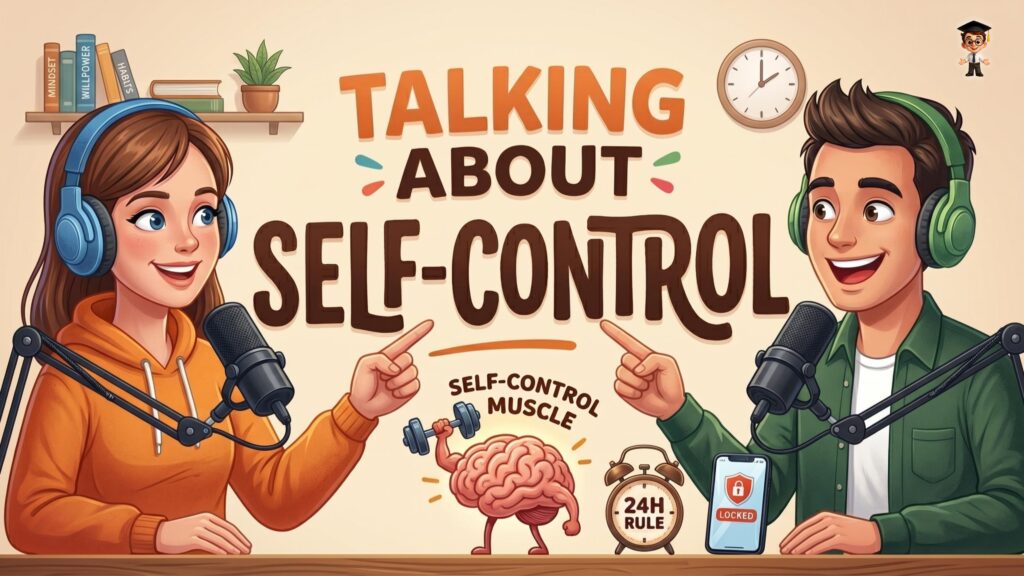
Hello everyone! Welcome back to Mr. English Channel, where learning English is easy and fun. Today, we’re diving into a topic that affects us all: self-control. Have you ever bought something you didn’t need, scrolled on your phone for hours, or put off important tasks? You’re not alone! Self-control is like a muscle that we all need to train, and it’s vital not just for personal discipline but also for mastering English.
Understanding Self-Control: The Boss of Your Choices
What exactly is self-control? At its core, it’s the ability to make better choices, even when you want to do something else. It’s about looking at your long-term goals instead of just giving in to short-term feelings. For example, choosing to study English when you’d rather watch a movie, or saying “no” to a sugary snack when your goal is to be healthy.
Self-control empowers you to be the “boss of your own life,” steering it towards your desired destination. It’s not about being a robot, but about being a better version of yourself, aligned with your true aspirations.
Why Is Self-Control So Hard?
We live in a world full of temptations. Our phones, with endless scrolling, offer quick rewards and easy fun, making it hard to focus on tasks that provide slower, but more significant, benefits like studying English. Our brains naturally love immediate gratification.
Beyond digital distractions, food is another common challenge. Who hasn’t struggled to eat just one chip from a bag? Procrastination, putting off work until “tomorrow,” is also a common way we lose self-control. We tell ourselves small lies in the moment to feel better, but these actions often hinder our progress in the long run.
Self-Control vs. Motivation: A Key Difference
Many people confuse self-control with motivation, but they are quite different. Motivation is a feeling – it comes and goes like the weather. If you only work when you feel motivated, you won’t work very often. Self-control, however, is the discipline to do the work even when you don’t feel like it. It’s a commitment, a promise you make to yourself, like “staying true to your word.” Motivation might start the journey, but self-control ensures you reach the destination.
Practical Strategies for Building Self-Control
The good news is that self-control can be learned and strengthened. Here are some effective strategies:
- Out of Sight, Out of Mind: If you don’t see temptations, you’re less likely to think about them. Hide snacks, put your phone in another room while studying, or simply avoid browsing tempting online stores.
- The 24-Hour Rule: When considering an impulse purchase, wait 24 hours before buying. Often, the next day, you won’t even want the item anymore. Your bank account will thank you!
- Honesty with Yourself: Acknowledge why you’re avoiding a task. Instead of saying, “I’ll do it tomorrow,” say, “I am avoiding this work because it is hard.” This honesty is the first step to changing the habit.
- Small Habits: Don’t try to change everything at once. Start with very small, manageable habits. For English learning, this could be just five minutes of study a day. Once you start, it’s much easier to continue.
- Pause and Breathe: When a strong emotional impulse arises, especially when you’re angry or “hangry” (hungry and angry), just pause. Take a deep breath or count to ten. This gives your brain a moment to think instead of just reacting.
Overcoming Setbacks: The “Flat Tire” Approach
Everyone makes mistakes and loses control sometimes. The important thing is not to give up entirely. Think of it like a flat tire: if you get one flat tire on your car, you don’t pop the other three! You fix the one. Similarly, if you eat one cookie, don’t decide your whole diet is ruined and eat the entire box. Just acknowledge the mistake and “get back on track” immediately, returning to your good habits.
Unexpected Boosters for Your Willpower
- Quality Sleep: This might surprise you, but good sleep significantly boosts your self-control. When tired, your brain craves easy rewards and quick hits of dopamine. Sleeping 7-9 hours helps your brain make better choices.
- Accountability: Sharing your goals with a friend or a community can be incredibly helpful. Knowing someone is cheering for you and might check on your progress makes it harder to fail. Our Mr. English Channel community is a great place for this!
- Manage Stress: When life gets stressful, self-control is often the first thing to disappear. Be extra kind to yourself during these times. Don’t let stress drive your choices; stay in the driver’s seat.
The Deeper Meaning of Self-Control
Paul shared a powerful perspective on self-control, highlighting its importance in his faith as one of the “fruit of the Spirit.” It’s seen not as a restriction, but as a path to freedom. If you can’t say no to anything, you aren’t truly free; you are a “slave to your desires.” Self-control is like the brakes on a car – you need them to stay on the road, reach your destination safely, and choose the life you want.
This skill helps in every part of life: improving relationships, health, and even your career. A boss who controls their temper, or a worker who arrives on time, demonstrates discipline and patience, qualities that are highly valued professionally. By learning self-control, you are becoming a better professional and a better student of English.
We encourage you to start today with one very small thing – maybe making your bed, or drinking a glass of water before your morning coffee. These “small wins” build confidence and prove to yourself that you can control your impulses. Remember, every small step counts. Don’t just look at how far you have to go; celebrate how far you have come!
If you’re finding this advice helpful for your English learning journey, we encourage you to read more on our blog. For more scientific insights into self-control, you might find this article on the concept helpful: Cambridge Dictionary: Self-Control.
Thank you for being part of our community. We love reading your comments. Don’t forget to like, subscribe, and share this video with a friend who is learning English. And if you’ve read this far, comment ‘BALANCE’ below to show that you understand what self-control is all about!