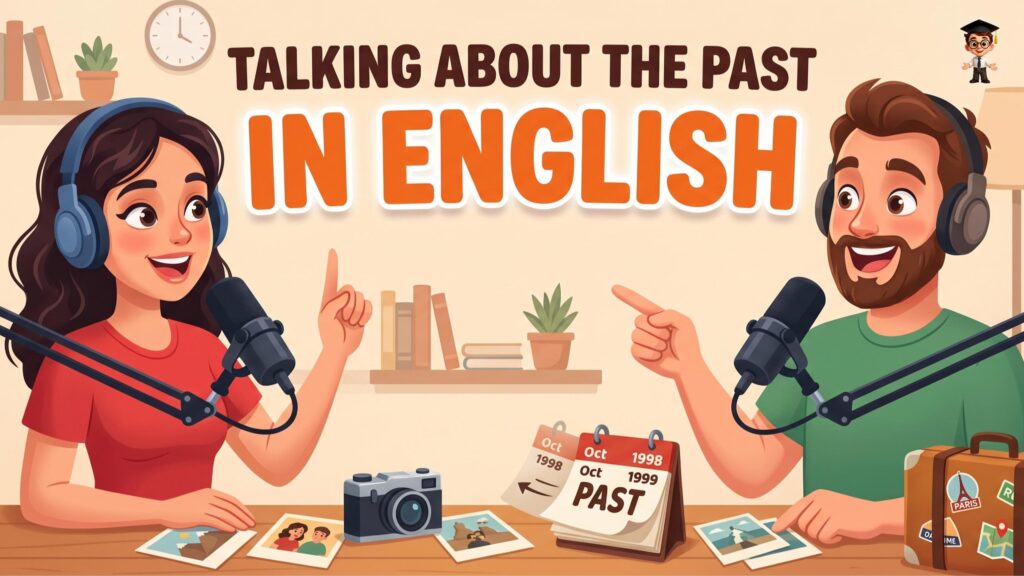
Hello, English learners! Welcome back to Mr. English Channel, where learning English is easy and fun. Today, we’re diving into an incredibly useful topic: talking about the past. Everyone has amazing stories to share, and mastering the past tense in English is your key to unlocking those memories and experiences. Let’s make learning easy and fun!
Understanding the Past Tense: Regular vs. Irregular Verbs
When we talk about actions that are finished, we use past tense verbs. You might have noticed words like “went,” “woke up,” “stayed,” and “cleaned” in everyday conversations. These are all examples of verbs describing things that happened previously.
The Simple “-ed” Rule for Regular Verbs
Many verbs are “regular,” which means they follow a simple pattern: we just add “-ed” to the end of the base form. For instance:
- I watched a movie.
- I played tennis last Saturday.
- I cleaned my kitchen.
Navigating Irregular Verbs
However, English also has “irregular” verbs that don’t follow the “-ed” rule. Their past forms are unique, and often, you just need to learn them. Here are a few common examples:
- “Go” becomes “went” (e.g., “I went for a walk.”)
- “See” becomes “saw” (e.g., “I saw a famous actor.”)
- “Wake up” becomes “woke up” (e.g., “I woke up early.”)
- “Buy” becomes “bought” (e.g., “I bought my first car.”)
While irregular verbs might seem tricky at first, many of them are used very often. Focusing on the most common ones will help you describe a huge part of your daily life and past experiences. You can find a comprehensive list of irregular verbs and practice your forms on trusted sites like Cambridge Dictionary.
Recounting Past Experiences and Memories
The past tense is perfect for sharing personal stories. Think about your first car, a funny thing that happened, or even what you did yesterday!
For example, Paul shared: “Yesterday, I woke up early and went for a long walk in the park. It was very peaceful.” Emily said: “I stayed at home yesterday, and I cleaned my kitchen.” These simple sentences paint a clear picture of their recent past.
When recalling a memory, you use verbs to describe feelings and actions:
- “I loved my first car because it gave me freedom.”
- “I drove that car to the beach every single weekend.”
- “I remembered my first bicycle; it was bright red.”
Talking About Past Habits with “Used To”
What about things you did many times in the past, but don’t do anymore? For these past habits, we use the phrase “used to.”
“Used to” describes a repeated action or a state that was true in the past but is different today. For instance:
- “I used to play the piano.” (Now I don’t.)
- “Paul used to play the drums when he was a teenager.” (Not anymore, luckily for his parents!)
- “I used to have very long hair.” (Now it’s shorter.)
- “I used to live in a small village, but now I live in a big city.”
Describing Past Trips and Events
Vacations and significant life events are rich sources for past tense practice. Remember to use “was” and “were” for descriptions related to the verb “to be” in the past.
- “Last year, I went to Italy. It was an amazing experience.”
- “I visited the Colosseum and the Vatican. I took so many photos.”
- “I was lucky. The sky was clear when I saw Mount Fuji.”
- “We were happy.”
- “They were at the party last night.”
Mastering Negative Sentences and Questions
Sometimes, we need to say what didn’t happen or ask questions about the past. This is where “did not” (or “didn’t”) comes in handy.
Forming Negative Sentences
To make a sentence negative in the past tense, use “did not” or “didn’t” followed by the base form of the verb (not the past tense form!). This is a common mistake, so remember:
- Incorrect: “I didn’t went to the gym.”
- Correct: “I didn’t go to the gym today.”
- Incorrect: “I didn’t saw the movie.”
- Correct: “I didn’t see the movie.”
Asking Questions About the Past
To ask a question about the past, start with “Did” and use the base form of the verb.
- “Did you sleep well last night?”
- “Did you go to the cinema?”
- “Did you see that beautiful sunset?”
You can also use “Wh-” words (Where, What, Why, Who) before “Did” for more specific questions:
- “Where did you go on your last vacation?”
- “What did you eat for breakfast this morning?”
Turning Challenges into Stories: Real-Life Examples
Past tense is perfect for describing funny disasters or memorable challenges. These stories often stick with us!
- Paul’s cooking adventure: “I forgot to put water in the pot for the rice! The kitchen was full of smoke. We didn’t eat my rice. We ordered pizza instead, and we laughed about it all night.”
- Emily’s first job as a waitress: “I was very nervous. I dropped a tray with three cups of coffee. It was a mess!” Luckily, the customers “were very kind.”
Notice how verbs like “forgot,” “was,” “didn’t eat,” “ordered,” “laughed,” and “dropped” clearly narrate the sequence of events. For more examples and lessons on storytelling, you can always read more on our blog.
Key Takeaways for Confident Past Tense Use
Remember, practice is the key to mastering the past tense. Here are some final tips:
- Focus on Common Irregular Verbs: Words like “do” (did), “go” (went), “see” (saw), “eat” (ate), “buy” (bought), “have” (had), “get” (got), and “teach” (taught) are used constantly. Learning these first will give you a big boost.
- Use Timeline Words: Words like “First,” “Then,” “Suddenly,” and “Finally” help structure your stories and make them easier for listeners to follow.
- Describe Weather and People: Use “It was” for weather (“It was sunny”) and “was” or “were” for describing people or situations (“She was kind,” “They were at the party”).
- Tell a Story: Think about what you did yesterday, last weekend, or years ago. Share the steps of what happened.
- “Used To” for Old Habits: Don’t forget this versatile phrase for describing things you did repeatedly in the past but no longer do.
- Emphasize with “Did”: If someone doesn’t believe you, you can use “did” for emphasis, like “I did finish my homework!”
- Don’t Be Afraid to Make Mistakes: Even if you say “I goed” instead of “I went,” people will understand you. The more you listen and practice, the more natural it will become!
Talking about the past is truly like sharing a piece of yourself. It allows you to connect with others, tell your unique story, and paint vivid pictures of your life. Keep practicing, and you’ll be a past tense pro in no time!
We hope you enjoyed this episode about talking about the past. It was a pleasure sharing these tips with you. Keep practicing your English every day!
Thank you for learning with Mr. English Channel. We will see you next time! Goodbye!