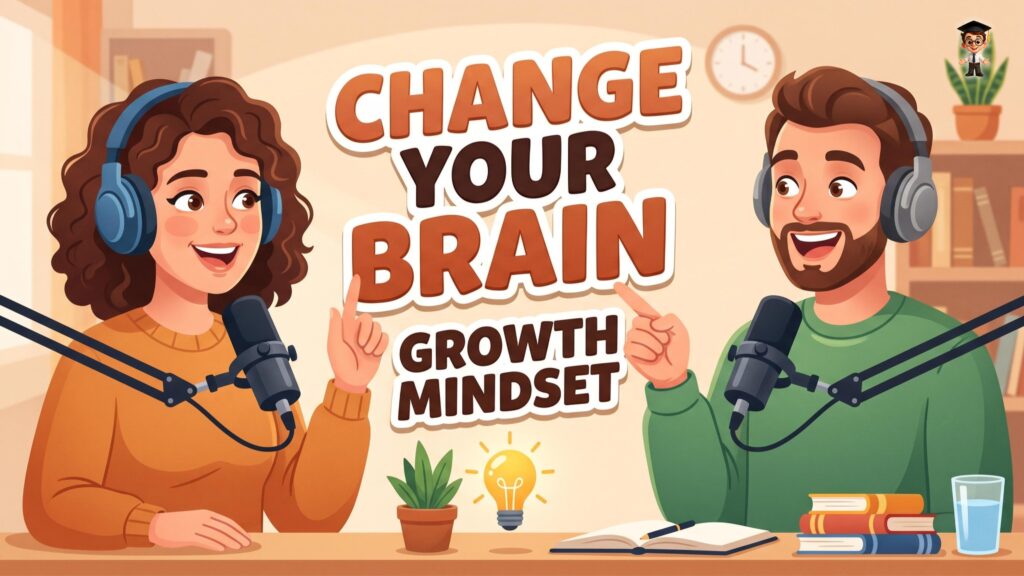
Hello everyone, and welcome back to Mr. English Channel! Today, we’re diving into a topic that can truly change your entire English learning experience: the “Growth Mindset.”
Many people believe their intelligence or ability to learn English is fixed—that they are either “good” at languages or they aren’t. But this idea couldn’t be further from the truth. A growth mindset teaches us that our brain is like a muscle; the more we exercise it, the stronger it gets!
Understanding the Growth Mindset
Imagine your learning journey like a small plant. With water and sunlight every day, it grows bigger and stronger. This is the essence of a growth mindset: the belief that you can learn anything if you put in the effort and keep trying.
Conversely, a “fixed mindset” is like a closed door. It tells you, “I can’t do this,” and stops you from even trying. For example, some might say, “I’m just not a math person” or “I’m bad at English grammar.” This limits your potential and keeps you from discovering what you’re truly capable of.
The Power of “Yet”
One of the most powerful words in the English language for fostering a growth mindset is “yet.” Instead of saying, “I can’t speak English well,” you can say, “I can’t speak English well… yet.” This small word completely transforms your perspective!
“Yet” implies that success is coming in the future. It means you are on a journey, making progress every single day. This simple linguistic shift helps relieve pressure and encourages patience with yourself, understanding that growth takes time, just like a tree doesn’t grow overnight.
Embracing Challenges and Mistakes
People who learn quickly often aren’t afraid of challenges. They see difficult tasks as opportunities to grow, not reasons to quit. When you encounter a long or difficult English word, instead of feeling nervous, think: “If I learn this, I will be smarter than before!” This positive outlook helps your brain create new connections, making your learning “bridge” stronger with every practice.
Mistakes are not failures; they are proof that you are trying! Many students feel ashamed when they make an error, but we need to change that feeling. Humility is knowing we don’t know everything, and a mistake is simply a sign that we are attempting something new. Think of a baby learning to walk; they fall countless times but always get up and try again. We should approach learning English grammar or pronunciation with the same perseverance.
Talent, Hard Work, and Consistency
Some people have a natural “talent” for languages, but talent is like a gift that is useless if you don’t use it. Hard work and consistency are far more crucial. A person with less natural talent but more discipline will ultimately achieve greater success.
This is incredibly encouraging news for every English learner! It means you don’t need a special “English brain” to become fluent. You just need to show up consistently. Practicing for just fifteen minutes every day can make a huge difference over a year. Consistency is truly the key to unlocking your potential.
Learning Has No Age Limit
The idea that you are “too old to learn” is a classic fixed mindset thought. Your brain has an incredible capacity to learn and grow at any age. While the learning process might feel a bit different, the ability to expand your knowledge is always present. We see amazing students who are seventy years old, full of joy as they achieve lifelong learning goals. Learning is a beautiful journey with no age restrictions, all thanks to a positive attitude.
Cultivating Your Growth Mindset
Changing your thoughts is the first step to developing a growth mindset. Here’s how:
- Listen to the Voice: When you hear yourself say, “I am not good at this,” pause. Recognize that this is just a thought, not the ultimate truth.
- Replace Negative Thoughts: If your brain says, “This grammar is too hard,” reframe it as, “This grammar is a puzzle, and I am learning how to solve it.” Make it feel like a game or an interesting challenge.
- Embrace Curiosity Over Judgment: When you make a mistake in a conversation, instead of judging yourself, try to be curious: “Oh, that’s interesting! Why did I say that?” This scientific approach removes the emotional pain from errors.
- Develop Discipline: Discipline means doing what you need to do even when you don’t feel like it. Having a strong “why” – whether it’s connecting with people globally or advancing your career – can make discipline easier and provide immense strength.
- Choose Your Environment Wisely: The people around you significantly impact your mindset. Surround yourself with positive influences, those who encourage you and celebrate your progress. Our community here at Mr. English Channel is designed to be just such a supportive environment!
Navigating Learning Plateaus
It’s normal to feel like you’re not improving sometimes. Progress isn’t a straight line; there will be moments when you feel like you’re staying flat. These “plateaus” are actually your brain’s way of organizing and consolidating information. It’s like building a strong foundation underground—you don’t see the immediate progress, but it’s the most crucial part.
One day, suddenly, you’ll realize you can understand a movie or have a conversation without overthinking. That’s when the “building” appears! Trust the process and have faith that the seeds you’re planting today will blossom tomorrow.
A Practical Exercise for Growth
To start practicing a growth mindset today, try this simple exercise:
- Write down one “fixed mindset” thought you have about your English learning. For example, “I will never understand phrasal verbs.”
- Then, cross it out and write a “growth mindset” version. For instance, “I am learning phrasal verbs slowly but surely,” or “I am getting better at phrasal verbs every time I use them.”
Place this paper somewhere you’ll see it daily, like on your wall or mirror. Reading the growth version every morning can significantly change how your brain works. This practice helps you train your brain to adopt more positive and empowering beliefs, fostering a stronger growth mindset.
Paul’s Personal Growth Story
Even experienced teachers face challenges. When Paul first started public speaking, he was terrified. His hands would shake, and he would forget his words, feeling like a complete failure. He wanted to quit, thinking, “I am not a speaker.”
However, he remembered that everyone starts as a beginner. Instead of being angry at his mistakes, he decided to treat every speech as a lesson. He watched videos of himself, looking for one thing to improve each time. This growth-oriented approach transformed his “weakness” into a strength. Now, he enjoys speaking and has embraced many opportunities to help others, all because he moved past his fixed mindset.
Key Growth Phrases for English Learners
Remember these powerful growth phrases to help you on your English journey:
- Instead of “This is too hard,” say “This may take some time and effort.”
- Instead of “I made a mistake,” say “Mistakes help me learn.”
- Instead of “I’m not good at this,” say “I am training my brain to do this.”
Think of yourselves as “English Athletes,” practicing every day to become better and stronger. Learning a second language is a significant challenge, and you should be incredibly proud of your efforts!
Keep Growing!
A growth mindset isn’t just for English; it helps in your career, relationships, and health. It’s a way of living life with hope, looking at the future with a smile, and seeing endless possibilities. Even if today was a difficult day for your English studies, tomorrow is a new chance to try again.
Remember, don’t compare your Chapter 1 to someone else’s Chapter 20. Your journey is unique. Focus on your own progress, be patient, be consistent, and let your growth mindset shine bright. As Carol Dweck, a leading researcher on mindsets at Stanford University, explains, it’s about the belief that your basic qualities are things you can cultivate through your efforts.
We are very proud of all of you and love having you as part of our English family. If you want to dive deeper into language learning strategies and inspiring content, be sure to read more on our blog. You have the power to change your mindset, you are capable, you are strong, and you are growing!
If you enjoyed this episode, please like the video, subscribe to Mr. English Channel, and share it with a friend who is learning English. Let’s help everyone develop a growth mindset together!