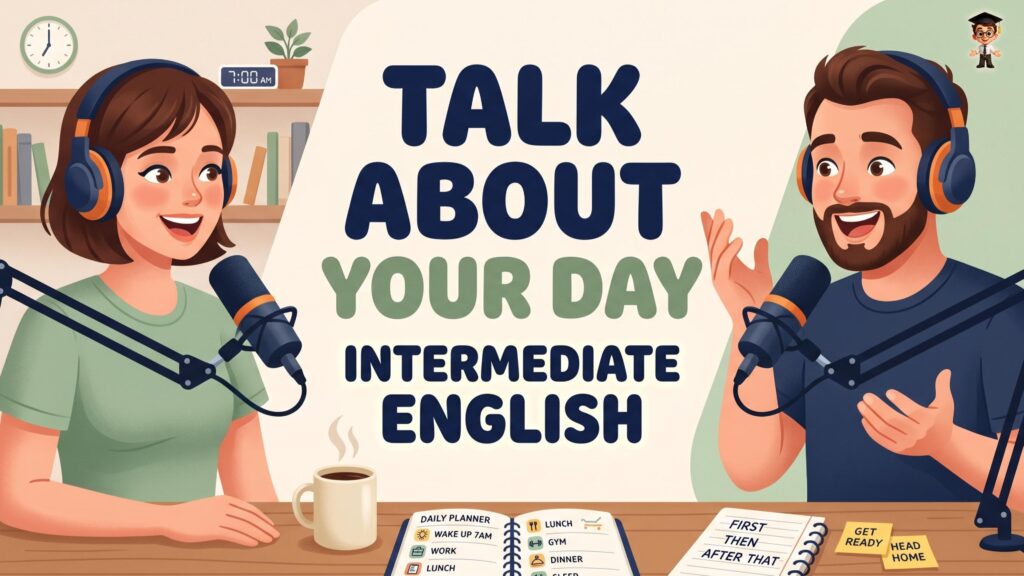
Hello, English learners! Have you ever wondered how to share details about your day in English without feeling stressed or searching for the right words? You’re in luck! Learning to describe your daily routine is one of the most practical and common ways to practice your English. It’s a conversation topic you’ll encounter every single day with friends, colleagues, or even new acquaintances. Let’s dive into making this easy and fun!
Starting Your Day: Morning Routine Vocabulary
The morning often sets the tone for the rest of your day, whether it’s calm or a little chaotic! Let’s imagine a common, slightly hectic morning to learn some key phrases.
Imagine your alarm didn’t go off, and you woke up late. You might start your story with a simple transition word:
- “First, I woke up at seven instead of six.”
- “Then, I had to run around the house!” (Meaning you were rushing to get things done)
You can then continue with more actions, linking them with helpful transition words like “then” or “after that.” These words act like glue, connecting your sentences smoothly:
- “Then, I made some quick coffee and left the house.”
- “After that, I quickly got ready for work.”
Talking About Your Regular Routine vs. Specific Events
This is a crucial point for English learners! When you talk about what you usually do every day, you use the present tense. But if you’re talking about a specific day, like today or yesterday, you use the past tense.
- Present Tense (Regular Routine): “Every day I drink coffee and eat toast.”
- Past Tense (Specific Event): “Today I drank coffee very fast. Yesterday I drank tea.”
This simple rule dramatically changes the meaning and makes your English sound much more natural.
From Getting Ready to Commuting
After your morning wake-up, the next step is often preparing for the day ahead. This is where the versatile phrase “get ready” comes in handy.
“Get ready” is a fantastic phrase because it covers many small actions at once, like brushing your teeth, getting dressed, or packing your bag. It saves you from listing every single detail:
- “I get ready for work at eight o’clock.” (This implies all those little actions without needing to say them!)
Next, you might travel to work or school. Here are some easy ways to describe your commute:
- “I commute to work.”
- “I go to work by car/bus/train.”
- “I take the bus.” (Or “I take the train,” “I drive to work.”)
Once you reach your destination, you can say: “I arrive at work at nine AM” or, more casually, “I get to work around nine.” The phrase “get to” is very common in American English for arriving at a place: “I get to school,” “I get to the office,” “I get to the gym.”
Your Workday and Afternoon Activities
The middle of your day is usually filled with work, study, and perhaps a break for lunch. Let’s look at how to describe these activities.
Lunch is often a highlight! You might say: “I usually have lunch at noon.” When you eat with colleagues, remember the word “co-workers”—it’s a professional and natural way to refer to the people you work with. For example, “I usually eat with my co-workers at a small cafe.”
In the afternoon, you might focus on your main responsibilities:
- “In the afternoon, I finish my tasks.”
- “I have a meeting with my manager at two PM.”
Wrapping Up Your Day: Evening Routine
The best part of the workday for many is when it ends! To describe leaving work, you can say, “I finish work at five o’clock,” or use a fun phrasal verb: “wrap up.”
To “wrap up” means to finish or complete something. So, you can say, “I wrap up my work around five PM and then I head home.” The phrase “head home” is another natural and warm way to say you are going in the direction of your house, implying relaxation after a long day.
Relaxing Before Bed
After you head home, what’s next? Many people enjoy changing into comfortable clothes, making dinner (or ordering delivery!), and then taking time to relax.
A beautiful phrase for preparing for sleep is “wind down.” To “wind down” means to relax your body and mind before bed. You might watch some television, read a book, or enjoy a warm cup of tea.
Finally, when it’s time to go to sleep, you can use the straightforward phrase: “I go to sleep at ten PM.” Or, you can use a common American idiom: “I hit the sack.” Don’t worry, it doesn’t mean anything violent! “Sack” here simply refers to the bed, making it a fluent and fun way to say you’re going to sleep. You can learn more about this idiom here on Cambridge Dictionary.
Answering “How Was Your Day?”
You won’t always need to tell your whole day’s story. Sometimes, a quick, general answer is perfect. The context of who is asking matters a lot!
If it was a good day:
- “It was great!”
- “It was pretty good.”
- “I had a productive day.” (Meaning you completed many tasks.)
If it was a difficult day:
- “It was exhausting.”
- “It was a long day.” (Meaning it felt long due to hard work, not more hours!)
- “It was pretty stressful.”
Bonus Phrases for Your Weekend!
Weekends have their own special vocabulary! Here are a few phrases to describe your free time:
- “Sleep in”: To sleep later than usual on a workday. “I love sleeping in on Saturdays!”
- “Stay up late”: To go to bed much later than usual. “I stayed up late on Friday night watching movies.”
- “Hang out”: To spend time relaxing with friends or family without a specific plan. Remember, the past tense is “hung out”! “On Sunday afternoon, I hung out with my family at the park.”
Boost Your English Confidence Today!
Learning these phrases and practicing them in real conversations is key to building fluency. The more you use words that directly apply to your daily life, the less likely you are to forget them!
Don’t just read—practice! For even more ways to improve your English speaking skills and get instant feedback, consider checking out Mr. English AI. It’s an incredible tool to build your confidence and help you use these new phrases naturally every single day.
We hope this guide has made describing your day in English much clearer and more enjoyable. Keep practicing, and don’t hesitate to read more on our blog for other helpful tips and lessons!
Thank you for learning with us! What time do you usually wake up? Share your morning routine in the comments below – we’d love to hear from you!