Hello everyone! Welcome to Mr. English Channel, where learning English is always an exciting journey. Today, we’re diving into a very real and important topic: how to talk about and cope with life’s truly challenging moments in English.
Life isn’t always easy. We’re not talking about small inconveniences like burning your toast or missing the bus. We’re talking about those deep, painful moments that make you want to cry or give up completely. These can be heavy storms like losing a job, receiving a difficult medical diagnosis, or the sudden end of a relationship. How do we express this kind of intense pain in English?
English Phrases for When Life Gets Tough
“My World Is Falling Apart”
When something truly terrible happens, a common and very powerful phrase we use is “falling apart.” You can say, “My world is falling apart.” This phrase paints a vivid picture, making you feel like everything around you is breaking into pieces. It means that nothing is going right, and you feel completely lost and overwhelmed by the situation.
“My Mind Is Racing” and “Overwhelmed”
When your world feels like it’s falling apart, it’s common for anxiety to take over. You might start to panic, imagining the worst-case scenarios. To describe a brain that won’t stop worrying, you can say, “My mind is racing.” This means your thoughts are moving too fast, like a race car, making it hard to think clearly.
Another excellent word for English learners at the A2 or B1 level is “overwhelmed.” Being overwhelmed means that a problem or situation is too heavy for you to carry alone. It feels like too much to handle. For example, you might say, “I am feeling very overwhelmed at work right now,” or “This bad news is completely overwhelming.”
Navigating Deep Sadness and Grief
“Hitting Rock Bottom” – A New Beginning?
Sometimes, being overwhelmed can lead to deep sadness or even depression, making it hard to even get out of bed. In English, when someone reaches the lowest point in their life, they are said to have “hit rock bottom.” Imagine being at the very bottom of a deep hole where things cannot get any worse. It sounds terrifying, but there’s also a positive perspective to this phrase.
When you hit the solid rock at the bottom, it means you have a firm surface to push yourself back up. The only way to go from there is up. This process takes time, and it’s important to allow people to feel their pain without forcing them to be happy.
“Toxic Positivity” – What NOT to Say
We’ve all experienced moments of intense sadness when someone tells us, “Just smile! Be positive!” In English, we call this “toxic positivity.” It’s when people pressure you to be happy or positive even when you are genuinely suffering. For instance, if someone loses a family member, saying “Look on the bright side” can be incredibly cruel. People need time to process their emotions and pain.
Understanding “Grief” and How to Offer Support
The process of feeling deep pain and sadness after a loss is called “grieving.” “Grief” is the profound, heavy sadness you experience when you lose someone or something incredibly important to you. This can be the death of a loved one, but it can also be the end of a long marriage, where you grieve the future you thought you would have. It’s a very painful and personal process.
So, what should you say to a friend who is grieving instead of offering toxic positivity? The best thing you can say is simple yet incredibly powerful: “I am here for you.” This means you’re not trying to fix their problem, but simply standing with them in their pain. You can also say, “Take all the time you need,” which gives them permission to be sad without pressure.
Practical Tools for Difficult Moments
Avoiding Impulse: “Take a Step Back”
When we are hurting or panicking, it’s common to “act on impulse.” This means making a fast decision without thinking about the future, usually driven by strong emotions. For example, if you get fired, you might impulsively sell your car on the same day – which is usually a terrible idea!
The alternative is to “take a step back.” This doesn’t mean literally walking backward! It means pausing, breathing, and looking at the situation from a distance before doing anything. This creates space between you and your panic, allowing you to breathe and think more clearly.
Finding Your “Anchor” and Taking “One Day at a Time”
In life’s biggest storms, having an “anchor” can provide stability. Just like the heavy metal object that stops a ship from moving in the wind, your anchor can be anything that provides you with strength and stability, like faith or a strong belief system. It helps you trust that you’re not alone in navigating the difficult waters.
When the future looks dark and scary, you don’t need to see the whole staircase; you just need to see the very first step. This leads to another powerful English phrase: “Take it one day at a time.” This is excellent advice for anyone going through a hard season. If a day feels too challenging, you can even take it “one hour at a time,” focusing only on surviving the next sixty minutes.
The Power of a “Support System”
Having a “support system” is crucial during hard times. This isn’t a computer term! A support system is the group of people you trust deeply – family, close friends, or even a good doctor. When your world feels like it’s falling apart, your support system can remind you that you’re not crazy and that you’re not alone.
“Comic Relief” and Finding Joy Amidst Pain
Humor can be a surprisingly effective tool during hard days. We call this “comic relief.” It means finding something funny to break the tension, even in a dark situation. Crying can be exhausting, and a small laugh can feel like a refreshing glass of cold water. Life can be heavy, but it doesn’t have to be serious every single minute. Joy and pain can truly exist in the same heart at the exact same time.
Building Resilience and Bouncing Back
Understanding “Resilience” and “Bouncing Back”
When things go wrong, it’s important to understand the concept of “resilience.” This is an excellent B1 vocabulary word. Resilience is the ability to recover quickly from difficulties. It’s how fast you can stand up after you fall down. Think of a rubber band: when you stretch it, it snaps back to its original shape. In English, we often use the phrasal verb “bounce back.” Resilient people bounce back from failure or setbacks.
Remember, resilience is not a race. It’s perfectly okay to rest on the floor for a while. Pushing yourself too hard can lead to “burnout.”
Preventing “Burnout” and “Starting from Scratch”
Burnout is a modern and increasingly common word. It describes a state where your mind and body are completely empty, leaving you with zero energy due to excessive stress. When experiencing burnout, you might find it impossible to work or think clearly, and you often become physically sick. If you hit this point, you might need to “start from scratch.”
“Starting from scratch” means beginning over from zero, building something entirely new. It can be scary, making you feel like you’ve wasted time. However, nothing is truly wasted. Every mistake and failure teaches valuable lessons that contribute to your new start.
Finding the “Silver Lining”
After difficult experiences, we often learn to find the “silver lining.” This is a famous English idiom. A lining is the material on the inside of a jacket. So, a “silver lining” refers to a bright, shiny edge on a dark cloud. Finding the silver lining means discovering the one good or hopeful aspect within a very bad situation. For example, if your car breaks down, the silver lining might be meeting a very kind mechanic.
It can be hard to see the silver lining while the storm is happening; you only see the dark clouds. Sometimes, it takes years to truly see the positive outcome from a past difficulty. Patience with pain is key.
The Importance of Connection and Support
“Hang In There” – Encouragement in Tough Times
Another great phrase to encourage someone is “Hang in there.” This common everyday English phrase vividly paints the image of holding onto a tree branch over a cliff. It means: don’t let go, keep holding on, even when it’s incredibly hard. If a friend is having a terrible week, you can simply say, “I’m sorry, man. Hang in there.” It’s casual but shows genuine care and tells them to stay strong.
How to “Struggle” and “Ask for a Hand”
True strength isn’t about never feeling weak; it’s about admitting you’re weak and asking for help. Asking for help can be one of the hardest things for adults to do, often due to pride. However, it’s a sign of maturity, not failure. To ask for help naturally in English, you can say, “I am really struggling right now. Can we talk?” The word “struggling” means you are fighting a difficult battle.
Alternatively, you can say, “I need a hand.” This is a friendly and simple way for A1 students to ask for physical or emotional help. Remember, when you ask for help, you’re not being a burden; you’re giving your friends a chance to show their love and support.
The Power of Empathy: “You Are Not Alone”
When things go wrong, we often hear, “What doesn’t kill you makes you stronger.” While a famous song lyric, sometimes trauma just makes you tired and sad, not necessarily stronger. Sometimes, the only victory is that you survived, and surviving is absolutely enough.
To truly support a friend in pain, you can say, “I am so sorry you have to go through this.” This shows deep “empathy,” which means you can understand and share another person’s feelings. It’s different from sympathy, which is feeling pity. Empathy is about sitting in the dark with someone, offering your presence without needing to bring a flashlight or fix anything. Another powerful phrase is “You are not alone in this.” This instantly makes a problem feel lighter, as loneliness can be the worst part of a tragedy.
It’s important to remember that people often care a lot, but they might not know what to say. If you are suffering, sometimes you need to tell people what you need. You can set a clear boundary by saying, “I don’t need advice right now; I just need you to listen.” This takes pressure off your friend and ensures you get the support you truly need.
Simple Actions for Grounding Yourself
Basic Needs: Sleep and Hydration
Beyond words, what actions can help when life is incredibly hard? The foundation is simple: drinking water and sleeping. It’s amazing how much a glass of water and a good nap can shift your perspective. If you don’t sleep, everything feels ten times worse.
“Grounding Yourself” with Your Hands
Another helpful action is doing something with your hands, like baking bread, painting, or gardening. This stops your mind from racing and brings you back to the present moment. We call this “grounding yourself” – focusing your attention on the physical world around you, rather than getting lost in a scary future.
The future is always a mystery, and we only have control over this exact second. It’s okay to have hard days; they are part of being alive. But remember, a bad day does not define your whole life. The storm will eventually run out of rain.
We’ve explored so many powerful English phrases today: “falling apart,” “mind is racing,” “overwhelmed,” “hit rock bottom,” “toxic positivity,” “grieving,” “take a step back,” “support system,” “comic relief,” “resilience,” “bounce back,” “burnout,” “start from scratch,” “silver lining,” “hang in there,” “struggling,” “I need a hand,” and “you are not alone.”
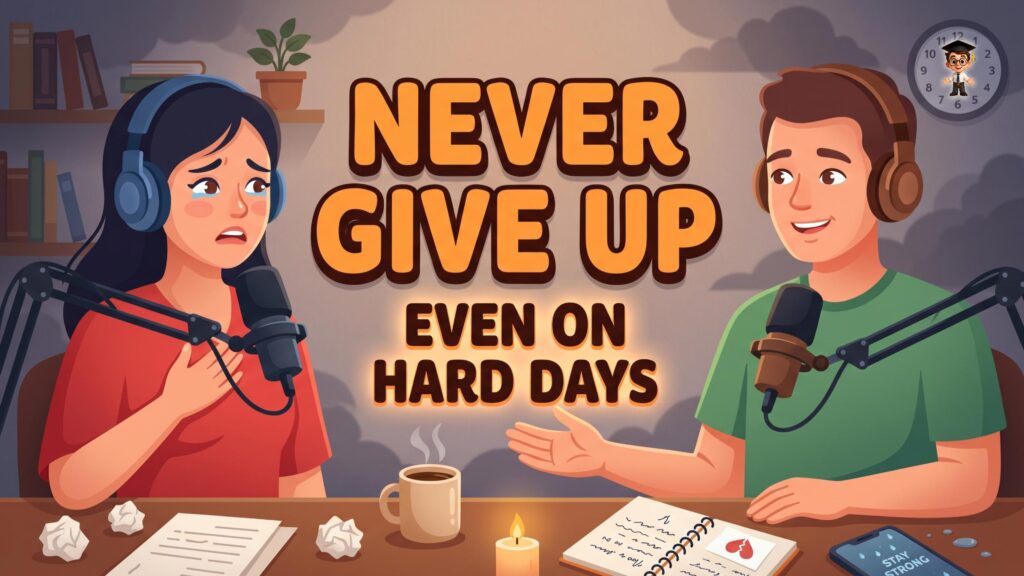
And the most important phrase of all: Never give up. Your story is not finished yet. Keep taking small steps, keep asking for help, and keep trusting the process. You are amazing, and we believe in you!
Thank you for spending this time with us. If you enjoyed this conversation and want to learn more, make sure to read more on our blog. Please remember to subscribe, like the video, and leave a comment below with ‘Never Give Up’! We love seeing our community grow. Keep practicing your English, stay strong, and we will see you in the next episode!